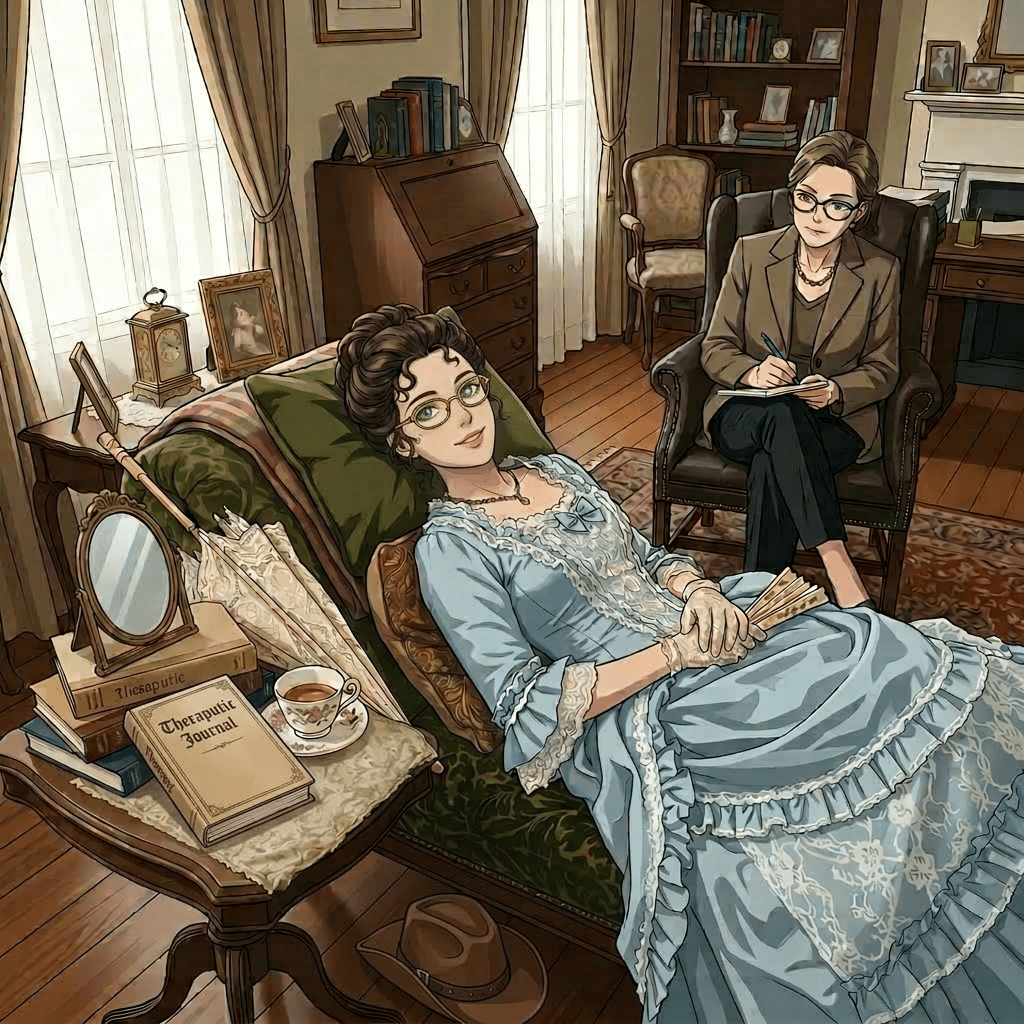
This past Friday, I received a simple homework assignment: “Beth, I want you to write and explore the depths of your emotions. Work on feeling.”
This came from my newish counselor after she decided that while I clearly experience emotion, she suspects I don’t experience much depth in my emotion. She suggested emotions might be foreign to me; I might be neurodivergent; however, in “Beth,” that translated to her suggesting I was the abandoned love child of Dexter Morgan and Sheldon Cooper. (I was today years old when I learned Sheldon had a last name.)
I have thoughts.
I have a blog.
I have a homework assignment.
Looks to me like what we have here is a “perfect storm,” which can only mean one thing…
We’re going to process… together!
To do that, you need to know a bit about how I was raised. (For my friend, HB, read that as “the way I was raised…” complete with that accent – you know it.)
Let’s start with some history. I’m obviously a Texan (no surprise to anyone here). I accept it for all it entails: the good, the bad, the obnoxiously proud, and sometimes (more often than I’d like) the “hang my head in shame, stop looking at my state – can we just not mention it again” parts. Now Texans didn’t really become Texans until March 2, 1835, when we gained independence and became a sovereign nation. Then, we didn’t join the United States until 1845. So today’s Texans are more likely than not descended from folks who “aren’t from around here.”
How many generations your family has been here matters to us, and fun fact, you can absolutely be judged by it. If I want to join a smug “I’m more Texan than you – get out of my state” fight, I’ll mention that I’m a fifth-generation Texan. But for the sake of this story, I’m also only a second- and third-generation Texan, depending on how you count it. The more recent family arrivals (refugees?) came here from the South, namely North Carolina, Alabama, and Georgia.
That combination gave me a complicated set of manners to live up to. Texans and Southerners both care deeply about politeness, but they care about manners differently. Texans lean toward a casual and good‑natured friendliness. Texans are direct, by and large, and are expected to have a certain amount of grit. Whereas Southerners tend to be much more ritualistic in how they conduct themselves. You see this in how they greet people, how they host them in their home, how they thank you, and how they apologize. And they apologize a lot. They value propriety – a lack thereof can bring embarrassment not only to yourself, but to your family.
So I grew up with overlapping rulebooks: the Texan one that says “be friendly, be helpful, handle your business,” and the Southern one that says “be gracious, be deferential, and don’t embarrass the family.” Both encourage a certain stoicism, but one is practical in its approach, and the other is performative, where no one has to be made uncomfortable by your feelings.
My mother was more Southern than Texan, and I was raised to behave in that same way, to be polite, pleasant, and never “too much.” To give you some idea of how that presents itself in me, I’m going to share the story of my mom’s passing. I was in the room when it happened. It was completely unexpected; we had just been chatting about movies. When the hospital chaplain arrived, I tried my hardest to comfort him, to make how he dealt with me easier. I didn’t want to seem difficult or make his day harder. On the inside, I was screaming, wanting him to go away, but I “hosted” him in her room. I was polite, lovely, the model grieving daughter. I shared stories about her, and I resented it. All I wanted was for him to leave so I could take a moment to break down, talk to her, and touch her hand.
I did the same when the police officer explained what happened with Jay and drove me home. I didn’t want to be a problem. I attempted polite conversation, responded when asked questions, and then settled for staring blankly out her window. As family arrived at my house, I apologized to everyone for his passing and internally admonished myself for being “too much” every time I put on an emotional “display” when my feelings became overwhelming. Ten years later, I’m still mortified that I behaved in a rude, unpleasant manner.
I was taught we do not cry in public, nor do we indulge in outbursts. Scenes are for those who lack control and lack class. Push it down and smile.
That upbringing is why I returned to work a week after Jay passed, even though I could barely keep up that mask, and boy, did it slip at times. It’s why people who don’t know me well have described me as stoic or strong during bad times, and polite, kind, and funny in the better times.
Now, before my friends balk at the notion of my holding back my feelings, they’re in a special trusted category. My good friends get the pleasure of seeing and hearing more than, well, anybody; they get me in my full glory. Bless them.
Fast forward to my most recent appointment with my counselor, where I politely listened to her hot take on my personality. We were discussing anger in relation to my frustration at handling a challenging situation. A person I had interacted with behaved rather “impolitely” and took it upon themselves to turn that into a fairly public display. I had to manage the situation. I’m going to skip a lot of the middle bit, but it involved a discussion of my triggers, the fast track to making me angry, my upbringing, and ended with the assessment that I experience emotions in a shallow way and that I needed a writing assignment. Needless to say, when asked for my thoughts, I smiled and thanked her and told her I’d work on my assignment.
And here’s my epiphany — my takeaway — my discovery, as it were, from tackling this writing assignment and working through all of my thoughts in this medium: outside that trusted circle, I don’t actually let people know me beyond a shallow level. I don’t give them access to the deeper parts — the grief, the anger, the fear, and even the way I profoundly love — because I was raised to believe those things were impolite, inconvenient, or “too much.” I’ve learned to curate myself for public consumption.
And that’s not going to change; it’s core to who I am.
But what I’d say to her, if I were ever going to see her again: You haven’t asked the right questions, but you’ve drawn some wrong conclusions. Do I feel deeply? Absolutely. I laugh so hard I get side stitches, where the pain makes me laugh even harder while I’m holding my sides and saying “ouch” every time I can catch my breath. I’ve cried so much I thought I wouldn’t know a day of relief. I’ve been so scared I may have peed a little (hey, it was a big guy in a clown mask holding a toy chainsaw, and he touched my leg with it — clowns are horrifying — big men in clown costumes? seriously horrifying). I’ve been so excited about a surprise that I started jumping up and down, clapping, and then started tearing up.
Strong Language Warning: Also, I’d add a bit of the 5th‑gen Texan and end with a little “go fuck yourself, I was raised with Southern manners, I’m not a sociopath.”
Final aside: My old therapist, whom I can’t see thanks to insurance but whom I immediately tattled to (aka asked for her perspective) like a responsible adult, pointed out that the person said “neurodivergent” and didn’t say I was a sociopath. Then she added, “You know it’s not the same thing, Beth.” Fine. This is the last time I run the title of my blog post by her.
I’m Southern, not shallow; I just save the real stuff for the people who matter.


Leave a Reply