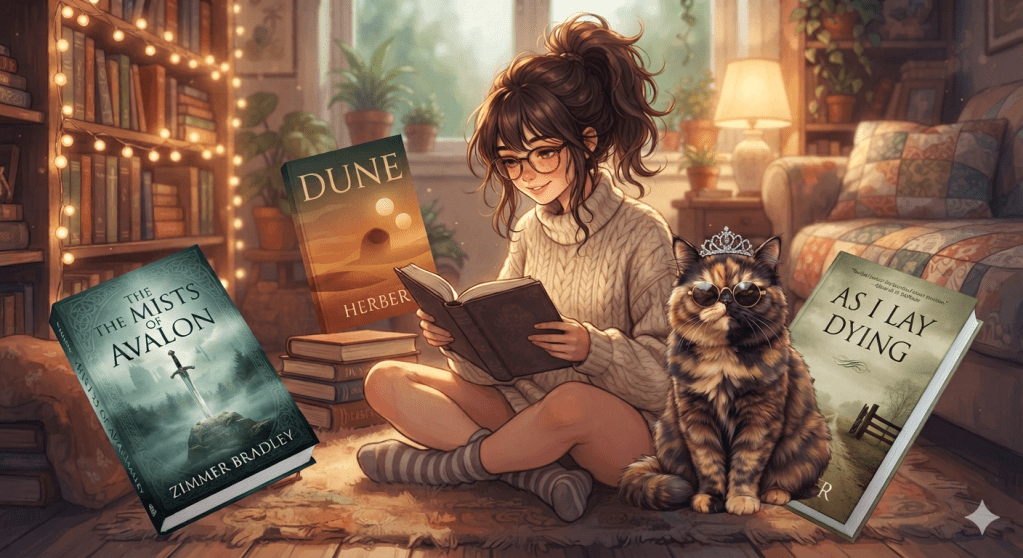
A friend of mine was recently featured on a podcast where she was invited to share a list of books that shaped her. Listening to her thoughts as she reflected gave me a small but beautiful window into her life, and it got me thinking about the books that shaped me.
I love books. I’ve even recommended a few over the years, but the more I pondered what I find to be a bit of a heady topic, the more I began to mentally flail. I genuinely can’t put a finger on a book that has had the same type of profound effect on my life as the books that have shaped her. Of course, that tripped off a bit of an existential crisis, like only a seemingly simple topic can do. I mean, why not use that opportunity to determine maybe my still waters aren’t so deep, as a person once described me. Maybe they’re just a little still puddle. Mayhap it’s a barely noticed clinging droplet to a leaf?
Mayhap I should stop using mayhap, stop overthinking things, and quit picking on myself for funsies? Options!
I finally landed on a few titles.
Warning: I will not express myself eloquently (we all know my limits), and honestly, no one is going to walk away saying, “That Beth – I learned so much; what a great thinker.” If you venture further, that’s really on you. I can’t be held accountable.
The Mists of Avalon, by Marion Zimmer Bradley
I will tell you all day long that I’m not a huge fan of fantasy when it comes to books (love them in movies), but there was a time when I was – a time when I was a nerdy, bullied teen who just wanted to sit in her room and lose herself in her books. That’s when I discovered this book – a retelling of the origin story of Morgaine le Fay and King Arthur from Morgaine’s point of view.
Bradley created a complicated/complex, somewhat flawed heroine, and it was the first time I’d seen an author take a well-known story and offer a completely fresh take from a different perspective. She took a villain and turned her into a flawed hero. Bradley’s words transformed Morgaine from some two-dimensional, sultry, incestuous temptress, bent on ruining a utopia (a tired trope), to a woman struggling as the world moves away from more pagan beliefs and embraces Christianity.
I still love that book, and I’ve never seen her as the villain again. Arthur and Guinevere? I can’t stand them to this day. I’m known to loudly boo if their characters appear in any movie, TV series, or water bottle sticker.
Dune, by Frank Herbert
A few years before I read The Mists of Avalon, when I was in 8th grade, I was in my room, sitting in a funk because a series I was reading had ended. By “funk,” I mean “full-blown teen ennui.” Enter my father, armed with his copy of Dune (and likely a glass of iced tea). It took me about 50 pages to get completely hooked.
This was the first time I experienced rich world-building, and then I devoured the first four books like an over-spiced sandworm heading for a thumper.
As I Lay Dying, by William Faulkner
Few authors compare to William Faulkner. His books rightfully appear on every AP English reading list, assuming some unelected ignorant zealot hasn’t been given authority to sanitize the bookshelves in your area based on their own morality. I digress.
As I Lay Dying was my first Faulkner novel. On the surface, it’s the story of a family traveling to bury their mother – an unnecessary Southern odyssey – and it touches on poverty, obligation, hardship, and cycles that refuse to break. It’s depressing. It’s heartbreaking. I kept rooting for the Bundrens, hoping their world might shift or soften, but every step forward seemed to come with another setback.
The book landed like a real gut punch, with every tragic sentence ringing true despite the absurdity threaded throughout their journey. You see, my family is Texan by way of the Old South (the Carolinas, Georgia, and Alabama), many having left economically depressed areas in search of new opportunities, only to find themselves back where they started – new hole, same old rut. I’ve seen the stoicism, the pride, and how generational poverty impacts your available options and your view of yourself and the world.
If I were going to break down why I love this book, it’s because it was the first time I’d read something about the South that wasn’t “pretty” or noble or glorified. It felt honest – raw in a way that matched the South I grew up around and knew, not the one people like to romanticize.
In Conclusion, Written by Me
Obviously (well, obvious to me; I can’t speak for you), this isn’t a complete list of the books that have shaped me. These are just the ones that bubbled up today while I was overthinking things. There are more. But something I realized a while back is that the books I love now all share one thing: they hit emotionally and show the world without trying to make it noble or pretty. Faulkner did that first for me, and apparently I’ve been chasing that particular gut punch ever since. Keep that in mind when asking for my book recommendations.
Also, I’m currently reading Dungeon Crawler Carl. I’m on book 5. Sometimes even I have to take a break from the punches.
 The Big Blue Mess
Leave a comment